
The I READ BOOKS Bookmark
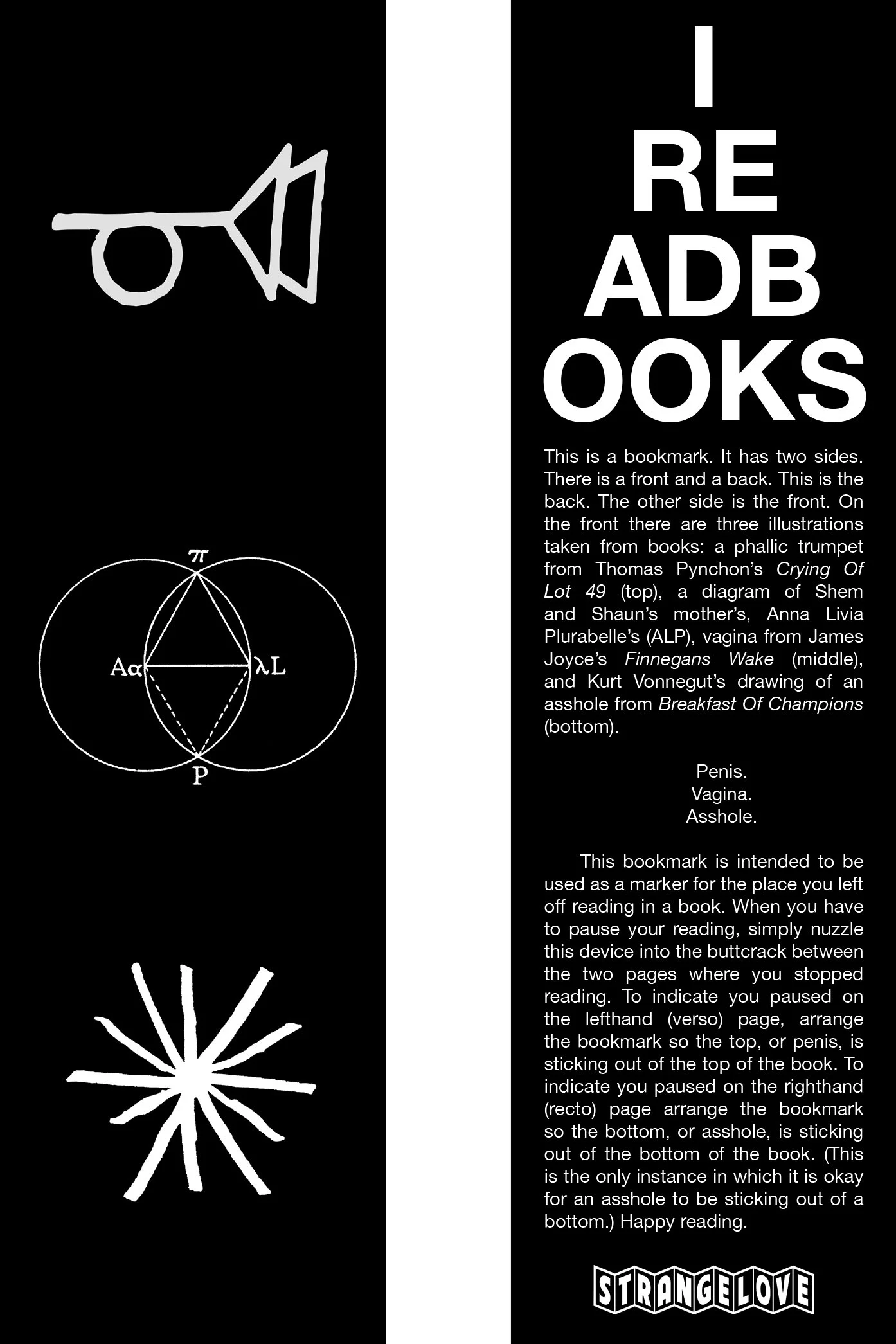
What authors/works have symbols, logos, or images that are part of the text and not an illustration of the text? We actually have two in hand: Finnegans Wake has two pieces of art that are part of the text and Vonnegut’s drawing of an asshole is also part of the text.
Sean came up with a third one: the peculiar horn symbol that appears in Thomas Pynchon’s Crying Of Lot 49. “Ohhh, yeahhh,” I said. Nice one, Sean.
But that’s it? I’ve been wracking my brain trying to think of other works that have similar non-lexical additions to the text and I can’t think of anything. There has been lots of imagery created around Big Brother in Orwell’s 1984, but none of it appears in the actual text. So we have been unable to come up with anything other than the three presented here. And, frankly, that’s fine because it turns out these three work very well together:
Vonnegut’s drawing is, of course, an asshole. As he clearly states: “This is my drawing of an asshole.”
The Vesica piscis in FW is the subject of a geometry lesson between the two brothers—it forms the first step in constructing an equilateral triangle in Euclid’s Elements—but here it is also a diagram representing their mother’s, ALP’s, vagina. (Euclid’s Vagina is a good band name.)
And while the trumpet in The Crying Of Lot 49 is the logo of an underground postal service, it is also a common phallic symbol. In fact, the line directly under it in the book, reads, “It might be something sexual.” In other words: penis.
You can’t imagine the joy we felt when we realized that the only three glyphs that we can find in all the world’s literature are a penis, a vagina, and an asshole.
And as we learned from the movie Team America, there are three kinds of people… :
“See, there's three kinds of people: dicks, pussies, and assholes. Pussies think everyone can get along, and dicks just want to fuck all the time without thinking it through. But then you got your assholes, Chuck. And all the assholes want us to shit all over everything! So, pussies may get mad at dicks once in a while, because pussies get fucked by dicks. But dicks also fuck assholes, Chuck. And if they didn't fuck the assholes, you know what you'd get? You'd get your dick and your pussy all covered in shit!”
The Mime Of Mick, Nick, And The Maggies
Part of the Strangelove “I Read Books” board collection
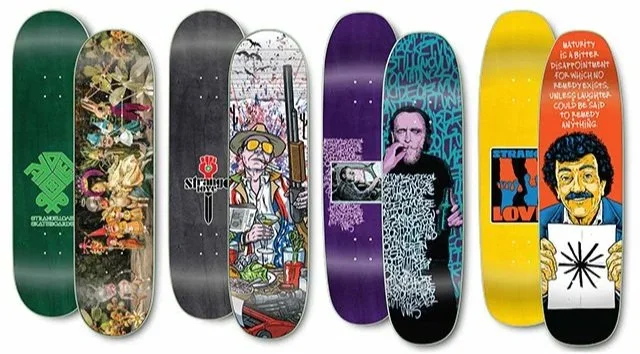
This is a graphic I did for a Strangelove literary inspired collection of four boards titled, “I Read Books.” The assignment was simple: create a graphic inspired by an author or work of literature. There are four artists, who chose four authors, and created four boards:
A. Andy (Jenkins): Charles Bukowski
B. Bratrud (Todd): Hunter S. Thompson
C. Cliver (Sean): Kurt Vonnegut
D. Dave (Carnie): James Joyce / Finnegans Wake.
(Note the first letters of everyone’s names.)
Each board came with a zine and a bookmark (see below). A friend of mine said the zine gave him a headache, so even if I had the room to share its contents here, I wouldn’t, but I will include the part that explains this collage. Don’t worry, it’s completely long-winded and overkill:
My collage illustrates Finnegans Wake II.1 (aka Book 2, Chapter 1) pp. 219 – 259, commonly referred to as “The Children’s Hour.” It is presented as if it were a play titled “The Mime Of Mick, Nick, and the Maggies,” and every member of the family unit makes an appearance, but the majority of the chapter is devoted to the children who are outside the pub playing games as dusk descends. The chapter begins:
Every evening at lighting up o'clock sharp and until further notice in Feenichts Playhouse. … Newly billed for each wickeday perfumance. Somndoze massinees. By arraignment, childream's hours, expercatered. Jampots, rinsed porters, taken in token. … The Mime of Mick, Nick and the Maggies, adopted from the Ballymooney Bloodriddon Murther by Bluechin Blackdillain (authorways 'Big Storey') …
The brothers, Shaun and Shem, along with their sister Issy, and her friends the Maggies, dominate the chapter. The brothers are referred to as Chuff and Glugg (respectively) in this chapter and, in the play, they assume the roles of Mick (the angel St. Michael) and Nick (the Devil). The Maggies (angels, Valkyries, Issy’s sisters/friends, etc.) are seven young girls who are also referred to as The Rainbow Girls (ROYGBIV), The Floras, and The Leap Year Girls (7 x 4 = 28 + Issy = 29, the number of days in a Leap Year February). Joyce scholars, Danis Rose and John O’Hanlon of the James Joyce Digital Archive (jjda.ie), summarizes the chapter thus:
Book Two opens with a delightful, if textually challenging, episode detailing the play-acting of the children before they are rudely brought home by their irate parents, HCE and ALP, to study and then be put to bed. Like all children in those days, they have stayed out too late. The three of them, Shem, Shaun and Issy, play a guessing game called ‘Colours’ or ‘Devils and Angels’ as they skip along the cobblestoned streets of old Chapelizod. Shem is cast as the devil and Shaun as the angel. Issy is the soul (or it could be the body) that they are contending for.
Writing to Harriet Shaw Weaver in November, 1930, Joyce himself explained it:
The scheme of the piece I sent you is the game we used to call Angels and Devils or Colours. The Angels, girls, are grouped behind the Angel, Shawn, and the Devil has to come over three times and ask for a colour. If the colour he asks for has been chosen by any girl she has to run and he tries to catch her. As far as I have written he has come twice and been twice baffled. The piece is full of rhythms taken from English singing games. When first baffled vindictively he thinks of publishing blackmail stuff about his father, mother etc etc etc. The second time he maunders off into sentimental poetry of what I actually wrote at the age of nine:
My cot alas that dear old shady home
Where oft in youthful sport I played,
Upon thy verdant grassy fields all day
Or lingered for a moment in thy bosom shade.
This is interrupted by a violent pang of tooth ache after which he throws a fit. When he is baffled a second time the girl angels sing a hymn of liberation around Shawn.
Colors. Note how there’s no U in my spelling of the word colors even though Joyce includes the U, colours, because I don’t think there should be a U in color. But I can’t bring myself to edit anything that Joyce has written. That would be like showing Gretzky how to shoot a puck. “No, no, lemme show you, gimme your stick…” But the subject of the colors is as good a place as any to start. When I first read Joyce’s letter I remember thinking, “Colors—colors of what?” Are they each thinking of a color? Or are they flowers (they are known as the Floras and there are lots of floral references throughout)? Are they the colors of the rainbow? What is the object of the color Glugg is trying to guess?
The Maggies, and ultimately Issy, are, as aforementioned, the subject of the brothers’ “battle” in this chapter. The girls all love Chuff (Shaun) because he’s a handsome angel, while they’re not so keen on Glugg (Shem) because he’s an ugly devil. So they gather round Chuff and tease Glugg. The Maggies are introduced in the opening playbill as, “THE FLORAS (Girl Scouts from St. Bride's Finishing Establishment, demand acidulateds), a month's bunch of pretty maidens.”
Whenever they’re mentioned in the text Joyce always uses flowery, sing-songy language. Here’s a passage describing them dancing in circles:
So and so, toe by toe, to and fro they go round, for they are the ingelles, scattering nods as girls who may, for they are an angel's garland.
Followed by what they’re wearing:
Catchmire stockings, libertyed garters, shoddyshoes, quicked out with selver. Pennyfair caps on pinnyfore frocks and a ring on her fomefing finger. And they leap so looply, looply, as they link to light. And they look so loovely, loovelit, noosed in a nuptious night. Withasly glints in. Andecoy glants out. They ramp it a little, a lessle, a lissle. Then rompride round in rout.
And finally their “RAYNBOW” names.
Say them all but tell them apart, cadenzando coloratura! R is Rubretta and A is Arancia, Y is for Yilla and N for greeneriN. B is Boyblue with odalisque O while W waters the fleurettes of novembrance. Though they're all but merely a schoolgirl yet these way went they. I' th' view o' th'avignue dancing goes entrancing roundly.
This, of course, is the source of the seven “RAYNBOW” girls in the collage who appear from left to right as:
RED: Rubretta = rubies = “rubies are red.”
ORANGE: Arancia is Italian for orange.
YELLOW: Yilla = yellow.
GREEN: Here Joyce goes for a bit of a stretch by using the last letter of the word for the acronym. “N for greeneriN,” or “green Erin”—Éirinn being the Irish word for Ireland.
BLUE: B is Boy Blue.
INDIGO: Again, bit of a stretch here, but he seems to be using the terminal O in indigo to form Odalisque? The painting, “The Grande Odalisque” by Ingres, is set in a blue/indigo interior. Then again, indigo has always been the queerest hue in the rainbow: this second “blue” was added by the deeply superstitious Isaac Newton only because he wanted seven colors in the spectrum and not six because six is “the witch’s number.”
VIOLET: And this one probably requires the most speculation, but I have it on good authority that Joyce might be referring to a line delivered by Ophelia in Hamlet (lots of Shakespeare in FW) where she says, “rosemary, that’s for remembrance.” Rosemary has purple flowers that bloom in November—hence “novembrance.” Also, in the language of flowers, violets symbolize constancy and faithfulness, which are sorta kinda synonyms of remembrance.
The figure in the center of their midst—or mist, since they are a rainbow—is their queen, Issy, “a bewitching blonde who dimples delightfully and is approached in loveliness only by her grateful sister reflection in a mirror, the cloud of the opal.” Issy’s color is the subject of Glugg’s inquiry and the answer to the game/puzzle, but unfortunately it’s a trick question because Issy’s color, heliotrope, isn’t technically a color. Heliotrope is a flower (purplish), a mineral/stone (aka a bloodstone because of its reddish spots), and even an orientation (plants that turns towards the sun are heliotropos).
And, as we learn through various sexual hints throughout the game, heliotrope is the color of Issy’s underwear. Glugg is trying “to catch her by the calour of her brideness” (calor = heat or passion, of Issy’s brideness).
Glugg approaches Issy and the Maggies three times and is given three guesses each time. Here is his first attempt:
—Have you monbreamstone?
—No.
—Or Hellfeuersteyn?
—No.
—Or Van Diemen's coral pearl?
—No.
He has lost.
Off to clutch, Glugg! Forwhat! Shape your reres, Glugg! Foreweal! Ring we round, Chuff! Fairwell! Chuffchuff's inners even. All's rice with their whorl!
Glugg is wrong, but it’s interesting that all of his guesses are Germanic, Satanic, and all concern stones: monbreamstone = brimstone, Hellfeuersteyn = Hell fire, Van Diemen = demon. And when he’s wrong, the Maggies all turn (heliotropos) towards their angel, their sun god, Chuff, while taunting the devil, Glugg. Glugg approaches twice more, offers six more incorrect guesses, loses the game, and is “sent back to hell” by Mick and the Maggies.
All point in the shem direction as if to shun
I’m not going to go any deeper into the story here except to mention that it is filled with sexual innuendos as well as many references to the Shem/Shaun brother conflict. The line above displays the ambiguity of the two as they are opposites, yet also complements them as they often the same at times: are they pointing in the same direction at Shem/Glugg as if to mock him (shun), or are they pointing at Shem/Glugg as if he is the new Shaun?