
Auricle Oracle
18” x 21”, collage, acrylic, oil pastel
-
She knows when one is coming on because she can smell it first. The breeze is sweet and reminds her of childhood in the hanging gardens of Thrig Island. It smells of manure and wild mint and fennel and the sea and like the times before They knew she had The Gift.
The transmission will soon arrive: someone has succeeded in reaching the auricle (nearly impossible) and asked it a question. The aromas and memories fade quickly and she begins to weep because she knows what’s to come. First the nausea. Then everything goes black.
When she awakes she is always lying face down in the grass. In her left hand a femur bone festooned with a bouquet of sage. She’s supposed to light it and wave it around, or something, but she never does. The number of horses varies, but there are always at least a couple. She is on Thrig again. But she is not on Thrig. She is Away.
The transmission begins as a murmur, she can hear a voice, then voices, but can’t make out words. The voices grow louder and louder until they become a deafening cacophony that usurps her entire being. She is wracked by the dissonant spectrum of all sound—she hears every sound that ever was, and every sound that will ever be, from a raindrop on a windowpane, to the eruption of a volcano, and everything in between: she hears the songs of Charlemagne accompanied by an inbred man on a banjo, and John Coltrane snorting cocaine in the middle of a herd of buffalo. Every sound, every instance when quiet is quelled, from the cries of a riotous crowd, to the crash of every tree that was ever felled, the sound of every smell—because let’s face it manure stinks out loud—she hears it all, every dog’s bark, every cow’s meow, every sound from history’s start til now. She hears the frustration at labor strikes, and all the music you like and dislike. She hears the waves crashing on the beach, to James screaming atop his giant peach. She hears everything from a butterfly flapping its wings, to all of the gusts and gales it brings, to a lion’s roar, a cricket’s chirp, a sticky drawer, plus every fart and every burp, from the fwip-fwap clap of a laundry snap, to a white rhino taking a gigantic crap, she hears every sound, all of the sound, it’s inside and it’s outside and it’s all around.
After swallowing every last bit of audible phenomena this sauerbraten universe has to offer, she compresses that sound into a tiny little bundle until it becomes infinitely small and implodes—there is a BANG—and the Supernoisa that was formed is discharged from her ear.
Portrait of Muninn
18.5” x 26.5”, collage, acrylic, oil pastel
-
One half of Odin’s pair of Ravens, Muninn, has a brush with death and needs to be recertified before she can fly again.
The Norse God Odin keeps two ravens as companions. Indeed, Odin is sometimes referred to as as Hrafnaguð, “The Raven God.” One raven is named, Huginn, the other, Muninn. Their names in Old Norse roughly translate to two overlapping definitions: “mind/thought” and “will/memory,” respectively. The ravens fly from Odin’s shoulders each morning and travel the universe, both forward and backward in time, and return in the evening to provide Odin with their news.
It's surprising how little attention has been given to these two birds as they were essential to Odin’s existence—he would not be the great Norse God he is without them. Odin was kind of a feeble fellow: he only had one eye, he was drunk on wine constantly, and he only spoke in verse—a poet. The ravens were extensions of him and so if he lost his “mind” or his “memory” he was essentially useless. Thus, Odin was very concerned about Huginn and Muninn. As Odin says in the Poetic Edda:
Huginn and Muninn
Fly every day
Over the great earth.
I fear for Huginn
That he may not return,
Yet more am I anxious for Muninn.
It’s interesting that he was more concerned about Muninn. Why? Could it be that Odin valued will and memory more than his mind and its thoughts? That is surely a concern, but another possibility is simply that Muninn was dumber than Huginn. There is ample evidence that this was true. Muninn was a very clumsy bird and a silly goose to boot. Although the real reason might be that Muninn was in dangerous situations more often than Huginn. Both birds fed on the carcasses of the dead, but those carcasses were to be found in very different contexts:
Two ravens flew from Odin’s shoulders;
Huginn to the hanged and Muninn to the slain.
“Hanged” is shorthand for anyone that has been executed whether it be by hanging, crucifixion, assassination, burned (at a stake or otherwise), drawn and quartered, firing squadded, decapitation, strangulation, blood eagled, disembowelment, flayed alive, asphyxiation, poisoned, starved, damnatio ad bestias, lethal injection, gibbeted, impaled, keelhauled, defenestration, drowned, boiled, stoned, immured, or chained to a rock for eternity [1], these corpses were all in Huginn’s jurisdiction.
Muninn’s dominion, on the other hand, was over those that were slain in battle.
Where heroes shrink; dark Muninn
Drinks blood from out the wounds.
—Thus sang Einarr Skúlason
It could be argued that Muninn’s buffet lay in more treacherous territory than Huginn’s and that’s why Odin worried more about her. Indeed he had cause for concern after a close call.
On one of Muninn’s daily tours of duty she was flying over the Euphrates River in Egypt when she paid a visit to the battlefield during The Seige Of Uruk (circa 2600 BC). She began munching on fallen Kishite warriors when she was surprised to discover that one of the fallen warriors, while fallen, was not FALLEN fallen. As Muninn began pecking at the warrior’s eyeball, he awoke and, with the sword he still clutched in his near dead hand, stabbed Muninn right in the throat. The spear passed completely through her neck and would have been fatal had her brooch not deflected the sword just enough for it to miss her esophagus, trachea, and spine. She was able to return to Odin that morning where he removed the spear and healed her wound with his magic.
Odin empathized with his bird’s suffering, it saddened him greatly to see her hurt, but at the same time he realized he needed to be stern. It’s for her own good. And so he demanded that Muninn take her Centennial Certification Test again, now. Once each century Odin requires his two ravens take a test to certify that they are still capable of flying in a straight line, that they can accurately record information, that they are following proper safety procedures, and, in Muninn’s case, to determine whether she can tell the difference between a cadaver and a live person. Because of Muninn’s error, Odin insisted she get re-certified before the scheduled test in the next century because he’s worried Muninn might have become mentally impaired. She is not allowed to fly until she passes the test. Muninn, of course, hates the test, doesn’t want to take it, thinks it’s stupid, and says she’s fine. They have been squabbling since the dawn of Time and they will continue to squabble til the sun turns black, the three cocks crow, and Ragnarök commences.
Here is a sampling of multiple-choice questions from Odin’s Centennial Certification Test:
When approaching a dead body, what is the first thing you should do to determine whether it’s dead or alive?
A. Poke it with a stick
B. Kick it
C. Ask if it’s okay
D. All of the above
If the body does not have a pulse, it is dead. Where is the best place on a human body to check for a pulse?
A. Anus
B. Wrist
C. Vagina
D. Scrotum
To determine whether the corpse is still breathing, the best orifice to hold a mirror over is:
A. Anus
B. Mouth
C. Ear
D. Tip of penis
If you shine a light into the eye of a dead person, the eye will:
A. Wink and blow you a kiss
B. Not do anything
C. Dilate
D. Shoot lasers at you
A dead body has a strong and unpleasant aroma, which of the following is not typical of a corpse’s stench?
A. It smells like a dumpster full of rotting Viking sharks, horse manure, a rotting horse, and a rotting baby horse.
B. It smells like a porta-potty overflowing with human feces, vomit, and old socks that have been fermenting in 100+ degree weather for a week.
C. It smells like a sewage pipe filled with decaying animal fat, dog shit, a corpse flower, and a ton of full baby diapers, all inside a cow’s asshole.
D. It smells like a lavender farm.
Now, dark, ominous Raven of yore, which one of the following is not knocking on Heaven’s door and should not be approached for he will live a little more?
A. The warrior’s body is a mangled open sore that pours forth great torrents of blood and gore, it will never be alive like it was before.
B. The fighter was not the victor, with a crimson stained spear running through his core, impaled on a lance, sweet life he will taste nevermore.
C. The warrior sits quietly at his chore on the floor sharpening his sword, he has vowed to settle the score, he longs for revenge, and nothing more.
D. The soldier’s head was blown off in the war, from his shoulders it was tore, a fatal injury no doctor can restore, thus he will neither speak nor breathe… nevermore.
[1] The mainstream version of the Prometheus story has an eagle eating his liver every day, but it was actually Huginn who ate Prometheus’ liver every day.
The Ginger Oracle
18.5” x 23”, collage, acrylic, oil pastel
-
When the Ginger Oracle goes into a trance, she can see everything, every which way, where, and when; future, past, and present; ominous, evil, or pleasant. She obtains her visions from her familiars, The Four O-Birds: an Owl, an Oriole, an Osprey, and a Silly ‘Oose (the latter is so silly that it’ll make you gigggggle so hard you’ll need every g you can [ ]et your [ ]rubby little hands on). The four of them fly around the world every day, one in each direction, North, South, East, and West, and they return in the evening with detailed notes from their global reconnaissance.
The four birds live together in a luxurious zingiber rhizome (aka a ginger root) that is divided into many palatial rooms and great halls covered with mirrors that reflect exquisite furniture, ornate chairs, comfy couches, and bodacious bird beds. The interiors are outfitted with iridescent wallpapers, oil painted portraits of birds in the style of Audubon, and all manner of rods, roosts, and perches hang from the ceilings like chandeliers upon which the birds alight. The carpets are strewn with seeds and droppings, the floors are disgusting, but everything else is pure opulence. This is where the foursome retires in the evenings to smoke cigarettes and drink sherry.
In the center of their rhizome’s interior, which somehow has a far vaster square footage than the outside dimensions should be able to provide, there is a small, but sparsely decorated apse that is empty of furniture save for a large, but low, marble basin in the very center. It is within this receptacle that the four O-Birds transmit and deliver their reconnaissance reports via regurgitation. The birds barf in the bowl, divulging everything inside of themselves including their entire accumulation of knowledge, and through a complicated series of pipes, aqueducts, viaducts, conduits, plumbing, tubes, canals, siphons, pumps, etc. their liquid transmissions are delivered directly into the Oracle’s bloodstream via IVs in her wrist and heart. Once under the influence of the O-Birds’ prophetic puke, the Ginger Oracle can see everything the birds have seen. Her head ablur, slobbering like a sprinkler, she falls into a trance and suffers prophetic visions.
She sees lava spewing from volcanoes, great white sharks playing pianos, all the long history of evolution, and the next Cuban revolution. She observes the birth of an elusive snow leopard, and the tea stains in the in your grandmother’s cupboard. She knows every thief who has stolen from porches, as well as the prehistoric artists who painted caves with torches. She’s seen a tiger’s teeth tearing into antelope flesh and Keith Haring wearing a cantaloupe dress. She saw the Chinese build The Ding Dong Mausoleum, gladiators battling monsters at the Colosseum, and the miles of hyphae that make up the world’s mycelium. She’s been witness to suicidal chatbots holding boycotts in empty parking lots where Irish astronauts, fraught with snot and hair tangled in knots, are not allowed to buy a shot at an English gin shop. She’s seen the rattled expressions of every man, woman, and child before they died on the field of battle, she is responsible for every disease that has afflicted cattle, and she was the inspiration for Barbie by Mattel—the original was a chubby, Southern Belle, but it didn’t sell very well. She knows the location of every sea shell, she can visit both heaven and hell, she has all the intel—even if it doesn’t smell, or no one will tell—she knows it all too well, thanks to her quadrilateral counsel of flying fowl who are always on patrol.
If you wish to know when the bell will toll, consult the Ginger Oracle.
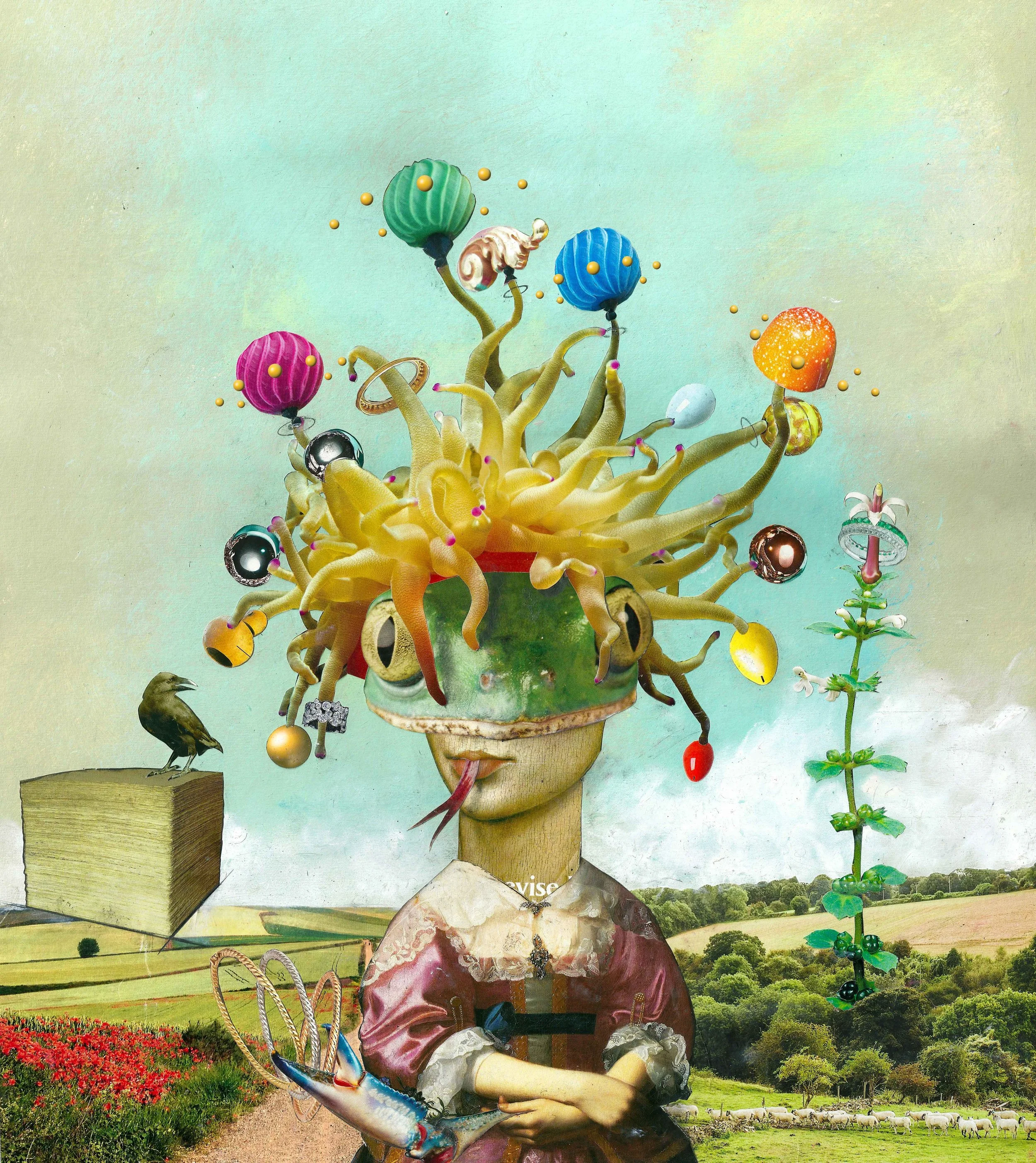
The Frog Oracle
21” x 23”, collage, acrylic, oil pastel
-
“The open-air site of Gönnersdorf was discovered in 1968 during the construction of a cellar for a private house. After digging through the pumice, bones, and stone slabs it became clear that it was a location of the late ice age. A wonderful inventory of ice age life was unearthed: pulverised red hematite, a fireplace, evidence of habitation constructions, a lithic industry, statuettes of ivory and antler, engraved slate plaquettes, jet beads, perforated animal teeth, and a well-preserved faunal record. Based on these finds it was evident that Gönnersdorf was a site of huge importance.”
—Bosinski, G., 1979: Die Ausgrabungen in Gönnersdorf 1968-1976 und die Siedlungsbefunde der Grabung 1968. Der Magdalénian-Fundplatz Gönnersdorf, Band 3.
One of the most important discoveries at the peculiar site known as Gönnersdorf, not far from the banks of the Rhine River in western Germany, is the first depiction of a frog drawn by humans. The frog was scratched into the slate rock wall about 15,000 years ago, at the end of the last ice age.
The location is overrun with frogs and local legends are teeming with stories of amphibious monsters. At the site’s center is a temple that was maintained by an ancient frog cult that inhabited the surrounding area from at least the end of the last ice age until the first century BC when the Romans, led by Emperor Augustus, sought to expand the Empire beyond the Rhine. The Romans, of course, razed the frog temple, but it was resurrected at least twice in the following centuries before finally being abandoned and disappearing into the earth circa 300AD.
The first frog ever drawn scratched into a block of slate by some distant ancestor wrapped in furs sketching by the light of a flame burning in the hollow of a bone lamp. Or maybe they drew it in the dark? Frankly, it looks like something someone tried to draw in the dark. It’s not a very good frog. Even with no Kermit, no Mr. Toad, no Jeremiah Bullfrog, no precedent whatsoever, it’s a pretty horrible drawing of a frog. Looks like chicken.
The ritual site and sanctuary was dedicated to a frog god who went by a variety of names over the centuries, all of which are cognate with its earliest known name: Frodsrennög. You’ll note that Frodsrennög is the name of the town Gönnersdorf spelled backwards. Apparently someone (an idiot) recorded the name of the town, Frodsrennög, backwards in the records as Gönnersdorf, and it stuck. (Back then “spelling” wasn’t a thing and you could write in whatever direction you wanted to.)
As further evidence of the influence of frogs in the area it should be noted that Frodsrennög is the origin of the English word frog. It was borrowed into Old English very early from the Gauls via the Celts, but was almost immediately dismantled by English speakers due to their remarkably deformed teeth that made them incapable of pronouncing the numerous pesky consonants of Frodsrennög. The middle of the word quickly eroded in the Englishman’s mouth and, in less than a couple of decades, the word went from frodsrennög, to frodög, to frooo0ooog1 , to eventually arriving at FROG. (This is not the accepted mainstream etymology of the word frog, by the way.)
While the temple at Gönnersdorf was a religious center dedicated to Frodsrennög, it was much more: there was an oracle, a sibyl, housed in a large crevasse underneath the temple who the frog god spoke through. Pilgrims visited en masse for the sibyl’s prophecies. …
To read the full story, click here.
The Wasp Oracle
22” x 27”, collage, acrylic, oil pastel
-
The Oracle Wasp’s Shamanic Rattle
Amazon reviews of a shaman’s ritual tool
Product Description:
Designed for meditation, healing, enchantments, and sound immersion with the professional Shaman in mind, our all-natural Shamanic Oracle Wasp Rattle creates an immersive sonic environment that promotes relaxation so you can enter your meditative space, and cross over the Dimensional Divide to dance with your psychic spirit guides. Each rattle is made from an authentic paper wasp’s nest harvested from Nature (all nests are abandoned and wasp free—no wasps are harmed). Each rattle is adorned with traditional artisanal carvings of birds, snakes, and wasps that provide grounding and protective energy. An antique brass-rod handle supplies enhanced traction as well as precision control that allows the professional Shaman to concentrate on the energies in their psychic journey, not their earthly tools. Also perfect for sound baths. The Shamanic Oracle Wasp Rattle measures 11" and weighs approx. 5 ounces. Sold individually. (Not recommended for amateur Shamans.)
Nancy Cheyenne
Not the shaman rattle I expected
Reviewed in the United States on April 4, 2025
Verified Purchase
This doesn’t really look or feel like an authentic shaman rattle. The material feels cheap, and the designs of wasps and snakes looks more like it was scribbled on than carved with intention. It does work as a rain stick, but only if you ask it nicely and if you tilt it very slowly. That might work for some folks, but it wasn’t what I was hoping for. The sound is ok.
Also, I’m docking points for the shipping method. They literally slapped a label right onto the stick and sent it bare. No box, no wrap—just raw stick energy in the hands of my mailman, who looked at me like I ordered something cursed.
Sylvia E. Martinez-Sanchez Thunder Eagle
Love my rattle
Reviewed in the United States on April 20, 2025
Verified Purchase
I have always used sage to clear out negative energy and bad vibes, such as screaming spiders, in my home. When I heard that wasp rattles were also good at removing bad vibes and screaming spiders, I purchased this rattle. It is beautiful and it has a lovely sound. I have not heard a single spider scream since. I'm going to buy more for holiday gift giving.
HELPFUL | REPORT
Acid Invader
Very powerful rattle
Reviewed in the United States on May 1, 2025
Verified Purchase
I bought this Oracle Wasp rattle for my ritual on the advice of my Shaman coach. I’m studying to become an accredited Alto Missayoq Shaman and a certified Transpersonal Therapist. This rattle has been one of the best additions to my Shamanic studies. I must tell you about my remarkable journey, if only to prepare others for the power of this rattle.
I began my first ritual ceremony with the new Oracle Wasp rattle the way I begin every ceremony: first, I set up my Mesa and I lay out my Mandala mat (from my Buddhist retreat in Tibet) that provides grounding and positive psychic strength. Before I kneel on my mat, I always light some Sacred Smoke (sage, copal, juniper, cedar, etc.) and make offerings by blowing smoke in the Four Directions. I ask the sky to open the cosmos and pour its light over me, then I ask the Earth for the Love of the Planet to rise up in me and connect my womb with Mother Earth’s womb.
Once my chakras have been aligned and I have achieved psychic equilibrium and a deep meditative state, I usually begin breathwork and drumming to call my spirit guides, but on this occasion ...
To read the full story, click here.